
SB IPB Equips Students with Splinting and Bandaging Skills for Managing Extremity Injuries
SB IPB Equips Students with Splinting and Bandaging Skills for Managing Extremity Injuries
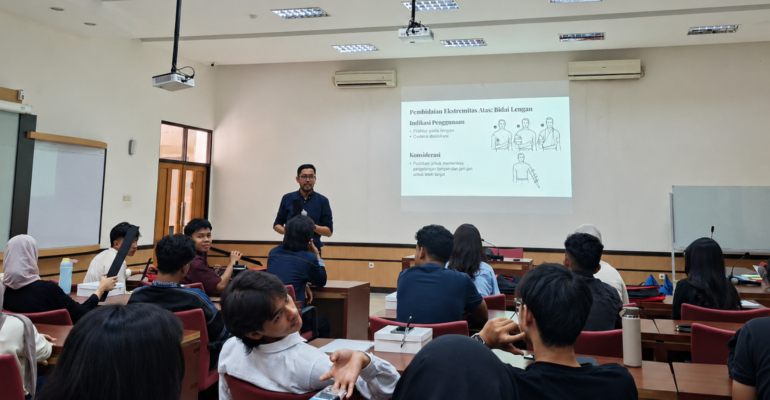
Bogor — As part of the Basic Life Saving (BLS) training series under the Life Ready program, the School of Business, IPB University once again held a session on “Splinting and Bandaging Methods for Extremities” on Friday, June 5, 2026, from 1:30 to 3:30 p.m. WIB. Attended by 23 undergraduate students, the session featured dr. Auliya Akbar, Sp.OT., Subsp.PL(K), who discussed the basic principles of managing extremity injuries through splinting and bandaging techniques as part of first aid.
In his presentation, the speaker explained that extremity injuries are commonly found in accidents, sports activities, and other forms of trauma. Proper initial management plays an important role in preventing the injury from worsening, reducing pain, and maintaining the stability of the injured body part before the victim receives further medical treatment.
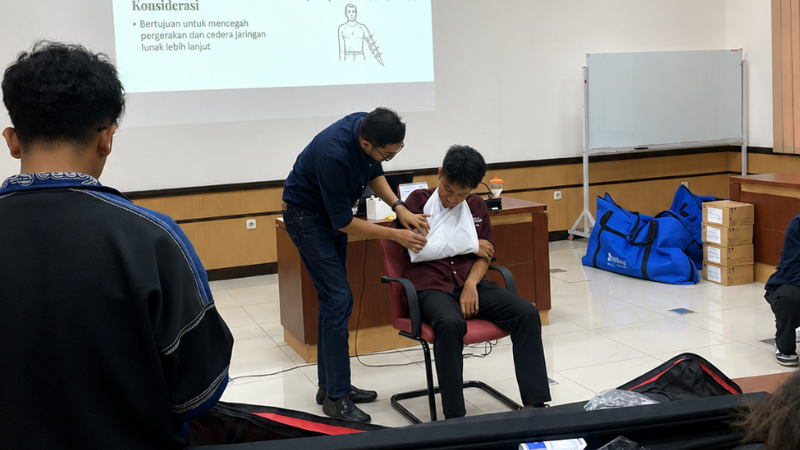 Participants were introduced to the basic principles of splinting as an immobilization method used to limit movement in the injured area, as well as bandaging techniques that help protect wounds, control bleeding, reduce swelling, and provide support to the affected extremity. In addition, students learned about various types of musculoskeletal injuries, including fractures, dislocations, sprains, and strains, along with the principles of initial management that can be performed by lay responders.
The session also covered the PRICE method, which stands for Protection, Rest, Ice, Compression, and Elevation, as a first aid approach for sports injuries and soft tissue injuries. The speaker explained that the proper application of the PRICE method during the early phase of injury can help reduce pain and swelling, prevent further tissue damage, and support the recovery process before the victim receives medical care.
To strengthen participants’ understanding, the activity continued with an interactive discussion and practical simulation. Through various case scenarios, students practiced determining the appropriate splinting and bandaging techniques, as well as applying the PRICE method according to the injury condition. This approach provided an applied learning experience while also training participants to assess a victim’s condition and determine first aid actions quickly, accurately, and safely.
Through this Basic Life Saving training series, the School of Business, IPB University continues to equip students with essential first aid skills that can be applied in everyday life. The competencies gained through this program are expected to enhance students’ preparedness in providing initial responses to injuries and emergency situations within the campus environment and the wider community.
Editor: Hapriza Aprilia